SENJIE Healthy & Technology
Choosing the right Surgical Spatulas requires more than comparing prices or polished product photographs. Global buyers must consider surgical application, material quality, ergonomic control, sterilization compatibility, and supplier reliability. A spatula used for delicate tissue handling should feel balanced in the hand, with smooth edges and a handle that remains secure under gloves. Small details matter. A rough finish can create cleaning concerns, while poor balance may increase hand fatigue during long procedures.
This guide reviews seven Surgical Spatulas for hospitals, distributors, and medical procurement teams worldwide. Each option should be examined through practical criteria, including stainless steel or titanium construction, corrosion resistance, blade shape, flexibility, and available sizes. Reusable models also require clear cleaning and sterilization instructions. Disposable versions need dependable packaging and traceability. Product certifications, inspection records, and batch information deserve equal attention. They are not decorative paperwork.
No single spatula suits every operating environment. A neurosurgical instrument may require different control from a model designed for general surgery. Local registration rules, import requirements, and hospital protocols can also change the purchasing decision. Buyers should verify these details with manufacturers and relevant authorities before ordering. Claims such as “premium” or “universal” should be tested against evidence, not accepted automatically.
Some weaknesses may remain. Online images rarely show grip texture or edge finishing clearly. Supplier responses can also be incomplete. Careful comparison is still worthwhile. The seven selections below are intended to support informed evaluation, not replace clinical judgment, institutional standards, or professional advice.
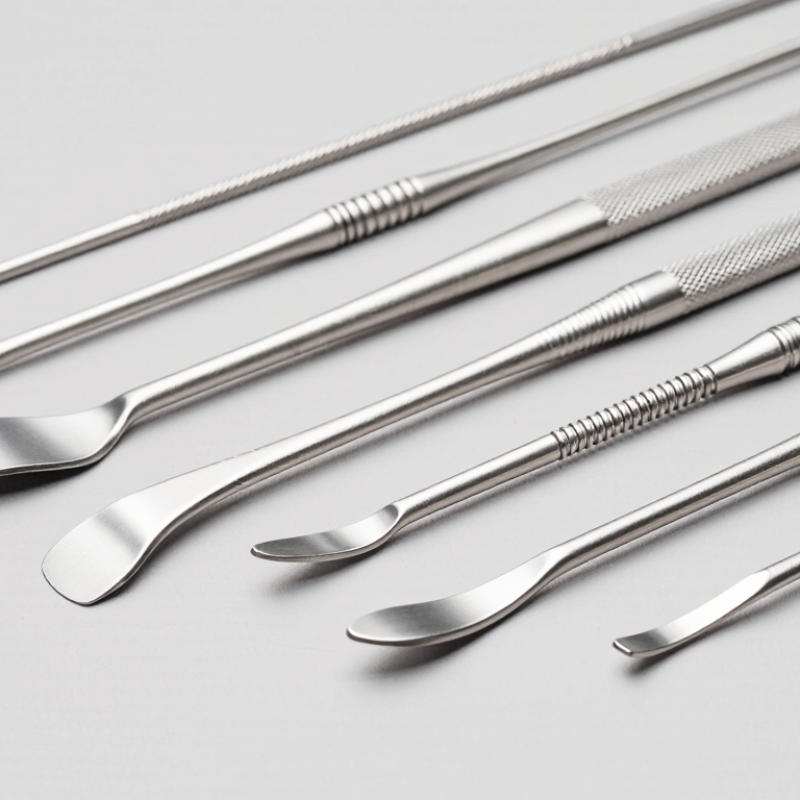
Surgical spatulas are handheld instruments used to gently retract, separate, or protect tissue during procedures. Their thin blades can improve visibility in confined areas. Common designs include flat, curved, narrow, and double-ended spatulas. Neurosurgery may require delicate blades for brain tissue. Ophthalmic procedures often need smaller, smoother tips. Dental and general surgery may benefit from broader surfaces.
The best choice depends on blade width, curvature, balance, and surface finish. A wider blade is not automatically safer. It may obstruct the field or create unnecessary pressure. Rounded edges can reduce tissue trauma, while a firm handle supports controlled movement. Stainless steel offers durability and familiar sterilization performance. Titanium can feel lighter, but its handling characteristics require careful evaluation. In practice, small differences in grip comfort become noticeable during long procedures. Fit matters. Cleaning access also matters.
Tips: Ask clinicians to test sample instruments with gloves. Check the working length against the intended procedure. Review the manufacturer’s material data, cleaning instructions, and quality documentation. Global buyers should also confirm applicable registration and import requirements in each market. Avoid selecting only by price; a low-cost spatula may have uneven edges or poor balance. One limitation is often overlooked: no single design suits every surgeon or procedure. Trial feedback should be recorded, compared, and revisited before purchasing.
7 Best Surgical Spatulas for Global Buyers?
When comparing seven surgical spatulas, buyers should examine material, balance, and reprocessing performance. Medical-grade stainless steel should resist corrosion after repeated cleaning cycles. A smooth, rounded edge helps protect tissue and reduce snagging. The handle should provide a secure grip during wet procedures. Small details matter.
The World Health Organization’s 2022 Global Report on Infection Prevention and Control states that strong infection-prevention programs can reduce healthcare-associated infections by 35–70% in many low- and middle-income settings. Therefore, a high-quality spatula should tolerate validated cleaning, disinfection, and sterilization processes. Look for clear material specifications, reliable welds, and surfaces without pits or crevices. Laser-etched identification can support traceability, but excessive markings may complicate cleaning. That trade-off deserves attention. Ergonomic balance also matters, especially during long procedures. A tool that feels slightly heavy may create hand fatigue, even when its finish appears excellent.
Tips: Ask for sterilization-cycle data, corrosion-test results, and dimensional tolerances. Inspect the working edge under bright light. Check whether the instrument remains comfortable with gloves. Request an inspection sample before bulk purchasing. ISO 13485-certified manufacturing can indicate controlled quality systems, but certification alone does not prove clinical suitability. Review supplier documentation, lot controls, and post-market feedback. Sometimes, the cheapest spatula becomes the most expensive after repeated replacement.
| No. | Spatula Type | Typical Working End | Common Material | Typical Overall Length | Key Design Features | Typical Surgical Use | Reprocessing Compatibility | Buyer Quality Check |
|---|---|---|---|---|---|---|---|---|
| 1 | Double-Ended Brain Spatula | Two flat, gently curved blades; approximately 8–20 mm wide | Medical-grade stainless steel; titanium versions are also available | Approximately 18–22 cm | Thin atraumatic edges, balanced handle, smooth transitions, and multiple blade widths | Neurosurgery and soft-tissue retraction where controlled exposure is required | Commonly compatible with steam sterilization when validated for the instrument | Check blade symmetry, edge smoothness, rigidity, surface finish, and absence of burrs |
| 2 | Malleable Ribbon Spatula | Broad, thin ribbon blade; approximately 10–25 mm wide | Tempered stainless steel or titanium alloy | Approximately 20–30 cm | Can be shaped for access, rounded corners, low-profile construction, and controlled flexibility | Neurosurgical and general deep-cavity retraction | Usually reusable and steam-sterilizable; bending limits must be specified by the supplier | Request information on bend recovery, fatigue resistance, maximum recommended deflection, and corrosion resistance |
| 3 | Periosteal Spatula | Single broad blade; approximately 8–18 mm wide with a rounded or beveled edge | Hardened stainless steel | Approximately 16–21 cm | Sturdy shaft, firm grip, polished working surface, and atraumatic rounded tip options | Separating or elevating periosteum and handling soft tissue around bone | Commonly reusable and compatible with validated steam sterilization cycles | Assess handle-to-shaft strength, blade stiffness, tip geometry, and resistance to staining or pitting |
| 4 | Dental and Oral Surgery Spatula | Small flat or slightly curved blade; approximately 3–10 mm wide | Medical-grade stainless steel; silicone-grip versions may be offered | Approximately 14–18 cm | Fine working end, ergonomic handle, rounded margins, and good visibility in confined areas | Oral surgery, periodontal procedures, tissue handling, and material placement | Metal versions are generally suitable for validated steam sterilization; grip materials require confirmation | Check working-end thickness, grip security, crevice-free construction, and compatibility with local sterilizers |
| 5 | Ophthalmic Micro-Spatula | Very narrow blade; commonly approximately 0.5–3 mm wide | Stainless steel or titanium | Approximately 11–15 cm | Micro-profile tip, precise control, rounded edges, and low glare surface options | Fine manipulation and separation of delicate ocular tissues | Often reusable and steam-sterilizable, subject to the instrument’s validated instructions | Verify tip dimensional tolerance, edge uniformity, alignment, surface polish, and packaging protection |
| 6 | Laparoscopic Spatula Electrode | Flat insulated blade; commonly approximately 5–10 mm wide | Stainless steel shaft with medical-grade polymer insulation | Approximately 33–45 cm | Long shaft, insulated exterior, compatible connector, and controlled monopolar or bipolar energy delivery | Electrosurgical tissue dissection and coagulation during minimally invasive procedures | Reusable models require validated cleaning and sterilization; insulation must be inspected before use | Confirm electrical ratings, connector type, insulation integrity, leakage-current compliance, and cycle life |
| 7 | Plastic or Silicone Tissue Spatula | Flexible flat blade; approximately 10–25 mm wide | Medical-grade silicone, polycarbonate, or other validated surgical polymer | Approximately 15–25 cm | Soft atraumatic surface, low tissue adhesion, lightweight construction, and nonconductive properties | Gentle tissue retraction, implant handling, and procedures requiring a non-metallic surface | May be single-use or reusable; sterilization method depends on the polymer and product validation | Check biocompatibility documentation, heat resistance, tear strength, flexibility retention, and visible cleanliness |
| Global buyer note: Dimensions and materials shown are common market configurations rather than universal specifications. Before purchase, verify the supplier’s drawings, material certificates, biocompatibility information, sterilization validation, packaging requirements, and applicable regulatory documentation for the destination market. | ||||||||
Global buyers should evaluate seven surgical spatula types by anatomy, access, material, and cleaning requirements. The flat spatula offers broad, even tissue separation in open procedures. The angled spatula reaches areas where a straight handle limits visibility. A curved spatula follows rounded anatomical surfaces and may reduce awkward wrist movement. The double-ended spatula provides two working widths in one instrument. It saves tray space, but its extra end requires careful protection during handling.
The fenestrated spatula has openings that can improve visibility and reduce surface pressure. The malleable spatula can be shaped gently for a specific approach, although repeated bending may weaken it. The micro spatula supports delicate work in narrow fields, where millimetre-level control matters. These seven types are not interchangeable. A wider blade can obstruct a small field, while a narrow blade may provide insufficient support.
Experienced procurement teams should check corrosion resistance, surface finish, edge smoothness, handle balance, and documented sterilization compatibility. Stainless steel is common, but the exact grade and processing quality still matter. Ask for dimensional drawings, inspection records, and traceability documents before purchase. Local regulations, hospital protocols, and validated cleaning cycles should guide final approval. No tool is perfect. Even a well-designed spatula can perform poorly when its size, angle, or flexibility does not match the procedure. Small trial evaluations may reveal practical issues that catalog specifications miss.
Selecting among the seven best surgical spatulas requires more than checking price. Material affects strength, tissue contact, weight, and cleaning performance. Surgical-grade stainless steel offers durability and broad steam-sterilization compatibility. Titanium is lighter and resists corrosion, but usually costs more. Some procedures may require polymer or silicone surfaces. These options can reduce tissue contact force, although they may scratch or deform more easily.
Design should match the procedure, not personal preference. A narrow, curved blade can improve access in confined fields. A wider spatula may provide steadier retraction over larger surfaces. Double-ended models save space but may complicate handling during rapid instrument changes. Smooth edges support safer manipulation. Textured handles can improve grip with wet gloves. Small details matter. I would still test balance in the hand before placing a large order.
Size selection should consider incision depth, working angle, and surgeon visibility. Confirm exact blade dimensions, handle length, and tolerances from technical drawings. Sterilization claims need careful review. Reusable stainless steel and titanium instruments commonly tolerate validated steam cycles, but the manufacturer’s instructions remain controlling. Heat-sensitive materials may require low-temperature methods, such as hydrogen peroxide plasma. Packaging, drying, and traceability also affect safety. Buyers should request validation data, cleaning instructions, material certificates, and quality-system documentation. One comparison table is never enough; local hospital protocols can expose weaknesses that specifications miss.
Choosing the seven best surgical spatulas starts with the purchasing environment, not the catalogue photograph. A useful shortlist includes atraumatic rounded edges, controlled flexibility, firm shafts, narrow blades, broad blades, insulated handles, and validated reusable designs. Each option should match tissue handling, visibility, access depth, and sterilization routines. A perfect spatula does not exist.
Global buyers should request material certificates, dimensional drawings, surface-finish data, and lot-level traceability. Stainless steel must resist corrosion after repeated cleaning, while polymers need documented biocompatibility and temperature limits. ISO 13485:2016 supports controlled medical-device quality systems, and ISO 14971 guides risk management. For reusable instruments, suppliers should provide cleaning and sterilization validation. “Autoclave compatible” alone is weak evidence.
Compliance also changes by destination. Buyers may need registration records, technical files, labeling translations, UDI data, or local representative details. The World Health Organization reports that one in ten patients experiences harm in healthcare, with more than half considered preventable (WHO, Global Patient Safety Report 2024). Small instrument defects can therefore create serious workflow risks. Check delivery history, complaint handling, inspection samples, and replacement lead times. I would not approve a large order from one sample. That feels efficient, but it is not reliable. Reports from the supplier should be verified against physical testing, because polished documents can still hide inconsistent edges, loose joints, or poor packaging.
Medical-grade stainless steel offers durability, corrosion resistance, and broad steam-sterilization compatibility. Titanium is lighter but usually costs more. Polymer or silicone surfaces may reduce tissue contact force. They can scratch or deform more easily.
Choose a smooth, rounded working edge. It can reduce snagging and protect tissue during manipulation. Inspect the edge under bright light. Tiny pits deserve attention.
Test the spatula with wet gloves. Textured handles can improve grip during damp procedures. Balanced instruments reduce strain during longer operations. A slightly heavy tool may still cause fatigue.
Match blade width and length with incision depth, working angle, and visibility. Narrow curved blades suit confined spaces. Wider blades provide steadier retraction across larger surfaces. Confirm dimensions from technical drawings.
Double-ended designs save storage space and offer two working profiles. They may slow rapid instrument changes. Handling can become awkward. Test the balance before ordering many units.
Request validated cleaning, disinfection, and sterilization instructions. Ask for steam-cycle data when using stainless steel or titanium. Heat-sensitive materials may require low-temperature processing. Packaging and drying also affect safety.
Request material certificates, dimensional tolerances, corrosion-test results, and lot-control records. Quality-system certification can indicate controlled manufacturing. It does not prove clinical suitability by itself.
Request an inspection sample first. Check welds, surfaces, markings, and grip comfort. Review post-market feedback and local hospital protocols. The cheapest option may require repeated replacement. That possibility is easy to underestimate.
Surgical Spatulas are essential instruments used to gently retract, lift, separate, or protect tissue during a wide range of surgical procedures. This guide explains how their shapes, angles, edges, handles, and working surfaces support different clinical needs. It also highlights the features that define a high-quality spatula, including precise workmanship, reliable strength, balanced handling, smooth finishes, corrosion resistance, and compatibility with cleaning and sterilization processes.
The article introduces seven commonly considered Surgical Spatulas types for global buyers, covering differences in material, blade design, size, flexibility, and intended application. It also provides a practical framework for comparing reusable and single-use options, evaluating sterilization methods, and reviewing supplier information. Buyers can use these considerations to assess product quality, documentation, packaging, consistency of supply, regulatory compliance, and long-term purchasing value while selecting instruments suitable for professional healthcare environments.
